Introduction
The construction industry is one of the most dynamic sectors, making it prone to change and disruption. Among many challenges the industry faces, budgeting remains difficult to control as it often shifts throughout the project timeline. While owners and managers may set initial estimates, over 85% of construction projects exceed their budgets, with an average overrun of 28%. A significant contributor to these overruns is workforce inefficiency, driven by the lack of effective management and proper utilization of on-site workers, which leads to low productivity and increased labor costs. According to McKinsey, boosting construction productivity in construction could save up to $1.63 trillion in annual savings. These inefficiencies highlight the urgent need for a solution to drive performance and cost control on-site.
True Cost of Inefficiencies
What is really driving up the cost of inefficiencies in construction sites? While many factors may play a role, main contributors still include project delays, financial penalties and overhead costs, and safety risks and compensation. These issues continue to cause delays, budget overruns, and operational setbacks.1.Project Delays
One of the most immediate and visible effects of workforce inefficiency is project delay. Late arrivals, idle time, time theft, and lack of accountability can move schedules up. Without proper coordination and oversight, even small issues compound into large disruptions. Statistics show that over 75% of projects are delayed by over 10% of their original timeline, adding weeks or even months of extra labor and equipment costs.2. Financial Penalties and Overhead Costs
Time is money in construction. Inefficient labor management often leads to extended work hours, overtime pay, and budget overruns. Furthermore, missing project deadlines can trigger penalties defined in contractual agreements. These overhead costs not only increase project budgets and lower profits but also weaken the company’s brand image.3.Safety Risks and Compensation
When teams operate without clear oversight or under stressful, disorganized conditions, the risk of accidents significantly increases. Slips, falls, and equipment mishandling are often the result of poor coordination and worker fatigue. In fact, 11% of budget overruns are caused by field productivity issues, often related to safety incidents. These incidents not only endanger lives but also lead to costly insurance claims, legal action, and worker compensation payouts, increasing the operational budget burden on the project.Root Cause of Inefficiencies
Construction inefficiencies are caused by a lack of real-time management and manual workforce tracking. Without real-time data, managers have limited visibility, slow decision-making, and reduced accuracy. However, many sites still depend on manual tracking methods, which are time-consuming, prone to errors, and lack the visibility offered by digital workforce management systems. Other than that, inefficiency could also be caused by miscommunications and inadequate supervision of safety equipment and hazardous areas. Poor communication between on-site teams and management often leads to misalignment, duplicated work, and project delays. Additionally, inadequate safety supervision increases the risk of injuries and large-scale site shutdowns, further disrupting construction progress and operational efficiency.How MytePro Workforce Management System Can Help
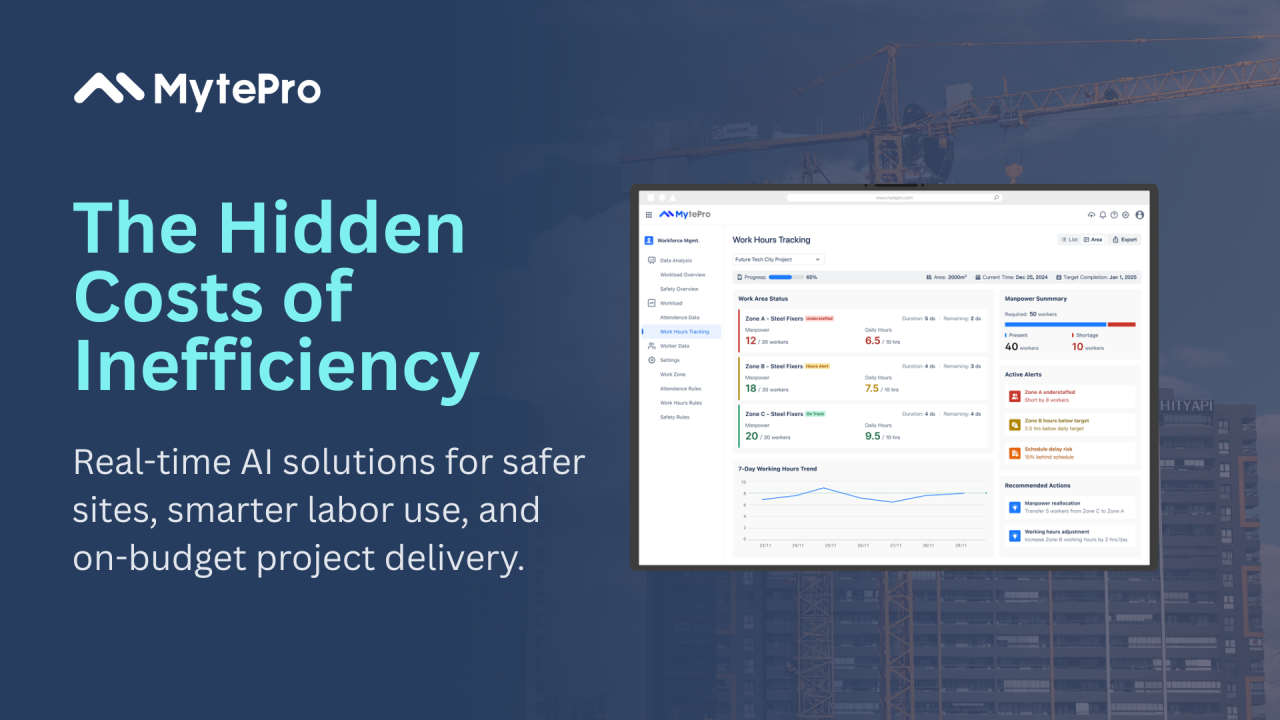
To address the issues mentioned above, MytePro offers smart construction solutions through AI and IoT, focusing on two main areas: improving work hour efficiency and enhancing safety on construction sites. Its real-time monitoring and automated workforce tracking directly solve challenges like poor visibility, manual workforce management, and communication problems. This helps streamline operations and reduce wasted time. Moreover, its smart alert system and geofencing features offer solutions to safety problems traditional construction sites experience, enabling quicker responses and stronger compliance with safety protocols.